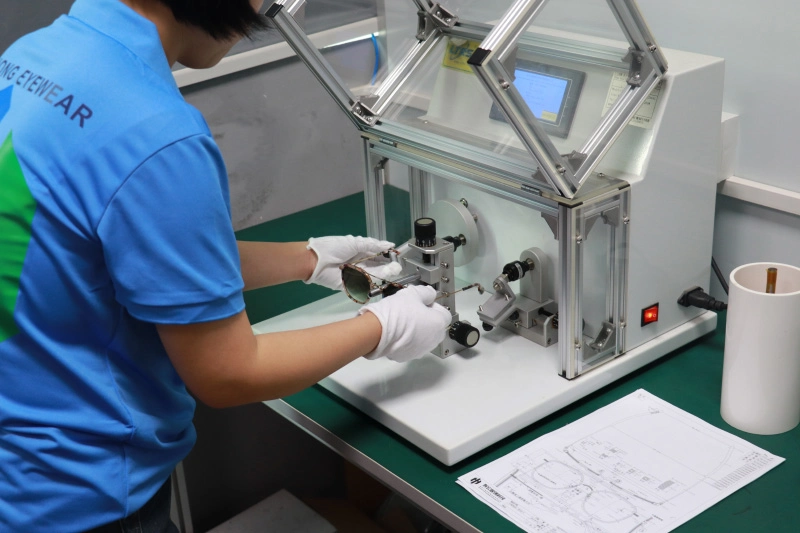
For eyewear brands and designers, few decisions carry as much financial and strategic weight as choosing when to commit to production tooling. A well-timed mold investment locks in consistent quality, reduces per-unit costs, and scales your collection efficiently. Pull the trigger too early, however, and you can sink thousands into tooling for designs that never sell, require major revisions, or fail fit-testing.
At Shenzhen Huihong Eyewear Technology, we guide independent brands, designer labels, and premium retailers through this decision every day. In this guide, we break down the clear signals that a design is ready for mold tooling—and the red flags that mean you should wait, iterate, or choose an alternative production path.
First: What “Mold Opening” Actually Means in Eyewear Manufacturing
In eyewear production, mold tooling (or “opening a mold”) refers to creating precision-engineered production tools that shape frame materials into consistent, repeatable parts. The exact process depends on your material:
Acetate frames require CNC-machined metal molds for cutting and forming acetate sheets, plus dedicated tools for rim shaping, lens groove cutting, and hinge seating.
Titanium and metal frames involve stamping dies, welding jigs, bending molds, and soldering fixtures to maintain precise geometry across production runs.
Injection-molded frames (TR90, plastic) require full steel injection molds with runner systems, cooling channels, and ejection mechanisms.
Mold costs range from $1,500–$8,000+ per style depending on complexity, material, and cavity count. Lead times typically run 3–6 weeks from design finalization to first shot samples.
5 Clear Signs Your Eyewear Design Deserves Mold Tooling
1. You have confirmed volume that amortizes the tooling cost
The most straightforward test is math. Calculate your break-even quantity by dividing the total mold fee by the per-unit savings compared to CNC prototype or hand-made production.
As a rule of thumb:
Acetate frames: Mold tooling typically pays off at 300–500 pieces per style
Titanium/metal frames: Tooling becomes economical at 200–400 pieces
Injection-molded TR90: Steel molds justify themselves at 500+ pieces
If you have confirmed wholesale orders, pre-sales, or consistent reorder history that exceeds this threshold, mold tooling is almost always the right financial decision.
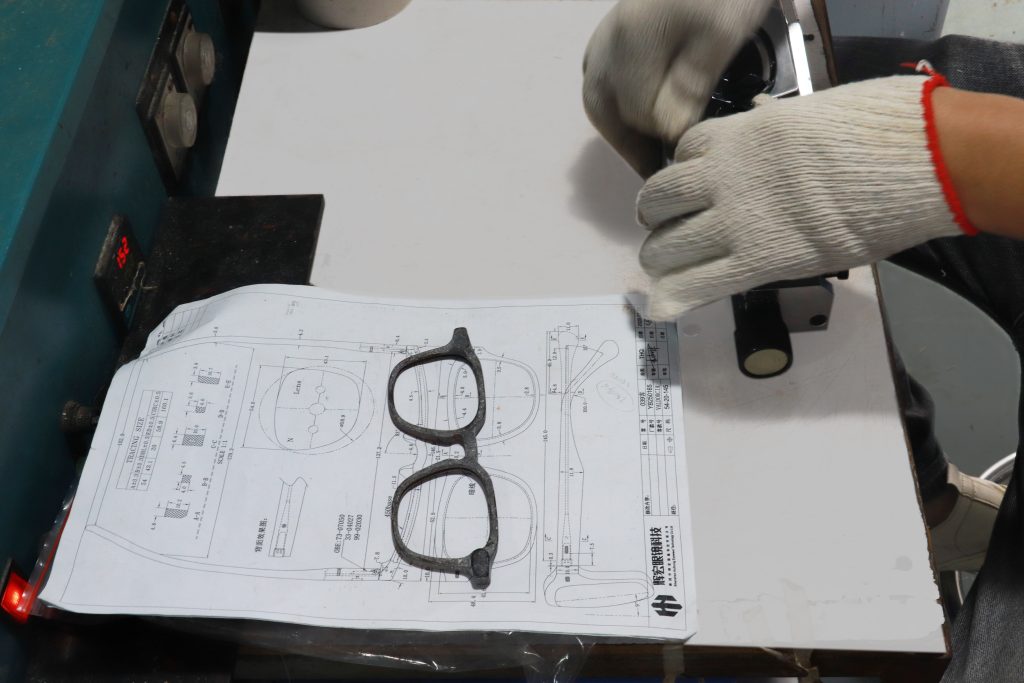
2. The design has passed full prototyping and wear-testing
Never open production molds on unproven designs. Your design should have already cleared:
3D printed or CNC prototype review for aesthetics and proportions
Wear testing across multiple face shapes to verify bridge fit, temple length, and weight balance
Functional testing including hinge durability, lens retention, and spring performance
Material and finish confirmation with signed-off color swatches and surface treatments
At Huihong Eyewear, we always recommend at least one round of physical prototypes before tooling commitment. Designs that skip this step have a 60% higher chance of requiring costly mold revisions later.
3. The design is a core or evergreen style, not a one-off trend piece
Mold tooling is a capital investment that delivers returns over time. It makes the most sense for:
Signature frames that define your brand identity
Classic silhouettes you plan to carry for multiple seasons
Best-selling styles you intend to reorder consistently
Core collection pieces available in multiple colorways
Trend-driven, seasonal, or highly experimental designs are far better suited to low-volume CNC production or limited hand-made runs, where you can test market demand without locking capital into tooling.
4. You require consistent precision and repeatability across reorders
Hand-made and CNC prototypes deliver beautiful individual pieces, but they cannot match the dimensional consistency of tooled production. If your brand demands:
Identical fit across every production batch
Interchangeable parts (temples, nose pads, screws)
Tight tolerances for lens glazing
Consistent wall thickness and structural strength
Reliable quality at scale
…then mold tooling is not optional—it’s essential. This is especially critical for prescription eyewear brands where optical alignment is non-negotiable.
5. The design features complex geometry that only tooling can deliver consistently
Certain design elements are simply not practical or cost-effective to produce by hand or CNC at any meaningful volume:
Intricate surface textures and patterns repeated across every frame
Precise undercuts, snap-fit features, and integrated hinge recesses
Complex 3D curves with uniform wall thickness
Multi-material constructions and co-molded features
Detailed engraving or logo embossing integrated into the mold surface
For these designs, the quality and efficiency gains from dedicated tooling far outweigh the upfront cost.
4 Red Flags: When Your Design Is NOT Ready for Mold Tooling
1. You’re still iterating on design details
If you haven’t finalized bridge shape, temple curvature, hinge placement, or overall proportions, do not open a mold. Even minor design changes can require expensive mold revisions ($500–$2,000+) and add 1–2 weeks of lead time.
Rule of thumb: If you can imagine changing anything about the design after seeing the first production samples, you’re not ready for tooling.
2. Your order quantity is small and one-time
For quantities under 100 pieces, mold tooling almost never makes financial sense. The per-unit tooling amortization will make your frames prohibitively expensive, and you’ll gain none of the efficiency benefits.
Low-volume orders are better served by:
CNC-machined acetate prototypes
Hand-made titanium/metal sample runs
3D printed display and fit samples
Soft tooling for 50–200 piece trial runs
At Huihong Eyewear, our low-volume custom production capability is specifically designed for this exact scenario—high quality without the tooling commitment.
3. The design is highly experimental or untested in your market
Innovative shapes, bold proportions, and avant-garde concepts are valuable for brand building, but they’re high-risk candidates for production tooling.
If you haven’t validated the design through:
Customer feedback and pre-orders
Retail buyer interest
Market research and competitive analysis
Wear-testing with your target demographic
…you’re gambling with tooling budget that could be better spent on multiple prototyping iterations or a small-batch market test.
4. Material and finish specifications are still undecided
Molds are engineered for specific materials with specific shrink rates, hardness, and forming characteristics. Switching from standard acetate to premium cellulose acetate, or from beta-titanium to stainless steel, after the mold is cut can render the tool completely unusable.
Lock in your material grade, color formula, and surface treatment specification before you approve mold production.
Material-Specific Considerations: Acetate vs. Titanium vs. Metal
Acetate Frame Tooling
Acetate tooling is generally lower cost than injection molds but still requires precision. Key decision factors:
Patterned acetate requires less custom tooling than solid colors, as the material itself provides visual variation
Complex laminations and layered acetate may require specialized cutting fixtures
Hand-polished acetate frames can often use simpler tooling since post-processing refines the finish
Titanium & Metal Frame Tooling
Titanium and metal frames involve multiple tools (stamping dies, bending jigs, welding fixtures) rather than a single mold.
Beta-titanium temples require dedicated bending molds to maintain spring-back accuracy
Welded construction needs precision jigs to ensure alignment consistency
IP plating and surface finishes are applied post-forming and don’t affect tooling design
Injection-Molded Frame Tooling
Injection molds are the most expensive upfront but deliver the lowest per-unit cost at volume.
Best for 1,000+ piece annual volumes
Ideal for TR90, nylon, and polymer-blend materials
Allows for highly complex integrated features and textures
The Decision Framework: A Practical 4-Step Test
Before you approve any mold tooling, run your design through this four-step evaluation:
Step 1: Volume test → Does your confirmed or projected quantity exceed the break-even threshold for your material?
Step 2: Design freeze test → Is the design 100% finalized with no pending changes?
Step 3: Validation test → Have you tested and approved physical prototypes for fit, function, and aesthetics?
Step 4: Strategic test → Is this a core/evergreen style that justifies capital investment?
If you can answer “yes” to all four, your design is ready for mold tooling. If you answer “no” to any one, consider prototyping further, running a small-batch trial, or sticking with low-volume production.
A Smarter Alternative: Low-Volume Production Without Full Tooling
Many brands assume the choice is binary: either open expensive production molds or settle for rough prototypes. That’s not the case.
At Huihong Eyewear, we specialize in low-volume, high-quality custom production that bridges the gap between prototyping and full tooling. Using precision CNC machining, skilled hand-finishing, and modular fixture systems, we produce 50–300 piece runs of acetate, titanium, and metal frames with near-production quality—no permanent mold investment required.
This approach lets you:
Test new designs in the market with minimal financial risk
Produce limited-edition and designer collaboration pieces
Fulfill small wholesale orders without tooling minimums
Iterate and refine between production runs
Gradually scale into full tooling when demand justifies it
Final Thought: Tooling Is a Commitment, Not a Milestone
Opening a mold isn’t just a manufacturing step—it’s a commitment to a design. The best brands treat tooling as the final step of product development, not the first step of production.
If you’re unsure whether your design is ready, you’re probably not. Take the extra week, order one more prototype round, and validate with your customers. The cost of patience is always lower than the cost of a bad mold.
Work With Huihong Eyewear
Shenzhen Huihong Eyewear Technology Co., Ltd. is a specialized manufacturer dedicated to the design, development, and OEM/ODM production of high-end eyewear. We collaborate with independent brands, designer labels, and premium retailers worldwide—bringing unique eyewear visions to life through exceptional craftsmanship and reliable service.
We specialize in acetate, titanium, and metal frames, with strong capability in low-volume, high-quality custom production. From concept prototyping to bulk delivery, we support brands through every step of the journey—with flexibility, speed, and precision.
Our clients span Japan, Korea, Europe, and North America, many of whom return to us not just for quality, but for trust and shared value.
Ready to evaluate your next frame design? Contact our engineering team for a complimentary tooling feasibility assessment and cost analysis.