Choosing the right lens material is one of the most critical decisions when selecting eyewear. The material directly impacts optical clarity, wearing comfort, durability, safety, and overall value. Whether you are sourcing for your eyewear brand, selecting frames for retail, or advising customers, understanding the core properties of each lens material helps you make informed decisions that match real-world needs.
In this comprehensive guide, we break down the four most widely used optical lens materials—CR-39, Polycarbonate (PC), Nylon, and Glass—covering optical specifications, advantages, limitations, and ideal applications.
1. CR-39: The Industry Standard for Everyday Optics
CR-39, short for Columbia Resin #39, is a thermoset plastic (allyl diglycol carbonate) first developed by PPG Industries in the 1940s. Originally engineered for aircraft fuel tanks during WWII, it transitioned to ophthalmic use in 1947 and has remained the benchmark for standard prescription lenses ever since.
Key Specifications
Refractive Index: 1.498
Abbe Number: 53–58 (one of the highest among plastic lenses)
Light Transmission: ~92%
Density: 1.32 g/cm³ (roughly half the weight of glass)
Heat Deflection Temperature: ~140°C
Advantages
Superior optical quality. Its high Abbe number means minimal chromatic aberration (rainbow-edge distortion), delivering sharp, natural vision across the entire lens surface.
Lightweight comfort. At roughly 50% the weight of crown glass, CR-39 reduces pressure on the nose bridge and ears for all-day wear.
Excellent processability. It accepts tints, coatings, and surface treatments extremely well—including anti-reflective (AR), anti-scratch, blue-light filtering, and UV-protective coatings.
Good impact resistance. Passes the FDA drop-ball test and is far less likely to shatter than glass.
Cost-effective. Offers the best balance of optical performance and price, making it the default choice for most everyday prescriptions.
Limitations
Low refractive index. At 1.498, lenses become noticeably thicker for mid-to-high prescriptions (above -3.00D), which can compromise aesthetics and fit with thin frames.
Moderate scratch resistance. Softer than glass; requires a hard coating to resist everyday abrasion.
Not ideal for rimless or drill-mount frames. Its lower tensile strength makes edge-mounting less durable compared to higher-index materials.
Best Suited For
Everyday prescription eyewear for low-to-moderate myopia/hyperopia
Reading glasses and single-vision lenses
Children’s eyewear (safety + affordability)
Brands targeting cost-conscious consumers without sacrificing optical quality
2. Polycarbonate (PC): The High-Impact Safety Material
Polycarbonate, commonly known as PC or “space lens,” is a thermoplastic polymer renowned for its extraordinary impact strength. Originally used in aerospace and bulletproof visors, it entered the eyewear market as the gold standard for safety and sports lenses.
Key Specifications
Refractive Index: 1.585–1.59
Abbe Number: 29–30
Light Transmission: ~89%
Density: 1.20 g/cm³ (the lightest of the four materials)
Impact Resistance: ~250× that of glass, 10× that of CR-39
Advantages
Unmatched impact resistance. PC absorbs shock without shattering, meeting ANSI Z87.1 safety standards and FDA drop-ball requirements with ease. It is the safest choice for active lifestyles.
Naturally UV-blocking. Blocks 100% of UVA and UVB radiation (up to 400 nm) without additional coating.
Thinner profile. A higher refractive index produces slimmer lenses than CR-39 for the same prescription, improving cosmetics for moderate prescriptions.
Ultra-lightweight. The lowest density of all common lens materials, maximizing wearing comfort.
Limitations
Higher chromatic aberration. With an Abbe number around 30, PC lenses can produce noticeable color fringing (especially in peripheral vision), which may cause slight visual discomfort for sensitive users during prolonged close work.
Poor surface hardness. PC scratches very easily; a premium hard coat is mandatory for everyday use.
Processing challenges. Its thermoplastic nature makes edging and coating application more demanding, requiring specialized equipment.
Best Suited For
Children’s eyewear and active youth frames
Sports sunglasses and protective goggles
Safety glasses and industrial eyewear
Rimless / semi-rimless frames (higher tensile strength at thin edges)
Drivers and outdoor enthusiasts (built-in UV400 protection)
3. Nylon: Premium Performance for Sport & Luxury
Nylon optical lenses—most commonly based on transparent polyamide (PA12 / TR-90)—represent the high-performance tier of plastic lens materials. Originally adopted by premium sports brands, nylon combines elasticity, clarity, and durability in a way neither CR-39 nor PC can match.
Key Specifications
Refractive Index: ~1.50–1.52
Abbe Number: ~40–45 (superior to PC)
Light Transmission: ~90%+
Density: 1.01–1.15 g/cm³
Heat Deflection Temperature: 110–135°C (short-term up to 350°C)
Advantages
Exceptional flexibility & memory. Nylon has a “shape memory” characteristic—it bends under impact and returns to its original form, making it highly resistant to cracking.
Strong optical balance. Its Abbe number is significantly higher than polycarbonate, delivering clearer peripheral vision with less chromatic distortion.
Superior thermal stability. Withstands extreme temperature fluctuations without warping, ideal for desert, mountain, and high-heat environments.
Excellent chemical resistance. Resists sweat, oils, solvents, and environmental degradation better than many other plastics.
Lightweight & comfortable. Density is even lower than CR-39 in some formulations.
Limitations
Higher material cost. Premium-grade transparent nylon (such as EMS Grilamid TR-90) commands a significantly higher price than CR-39 or standard PC.
Lower scratch resistance. Still requires hard coatings for daily wear durability.
Limited high-index options. Most nylon lenses sit in the 1.50 index range, so high prescriptions remain thick.
Best Suited For
Premium sports sunglasses (cycling, skiing, golf, water sports)
High-end designer and luxury eyewear lines
Frames intended for extreme temperature or harsh environments
Brands positioning durability and long-term comfort as core selling points
4. Glass: The Classic Benchmark of Optical Clarity
Optical crown glass was the original lens material and remains the reference standard for pure optical performance. While its market share has declined with the rise of plastics, it still serves specific niches where uncompromising clarity and surface hardness are required.
Key Specifications
Refractive Index: 1.523 (crown glass); high-index variants up to 1.90
Abbe Number: 59+ (the highest of all common lens materials)
Light Transmission: ~99%+ with premium coatings
Density: 2.54 g/cm³ (nearly twice as heavy as CR-39)
Surface Hardness: Mohs ~7 (virtually scratch-proof under normal use)
Advantages
Unrivaled optical fidelity. The highest Abbe number and best light transmission produce the sharpest, most color-accurate vision possible. For precision optical work, glass remains unmatched.
Superior scratch resistance. Glass is by far the hardest lens surface. With proper care, a glass lens can remain scratch-free for years.
Optical stability. Does not warp, deform, or degrade over time with exposure to heat, UV, or chemicals. Refractive index remains constant for life.
High-index capability. Glass can achieve refractive indices up to 1.90, making it viable for extremely high prescriptions where even 1.74 plastic lenses remain thick.
Limitations
Heavy weight. At roughly double the weight of CR-39, glass lenses cause noticeable fatigue during all-day wear, especially with full-rim frames.
Low impact resistance. Glass shatters on impact, creating sharp shards that pose a serious eye injury risk. It fails standard safety drop-ball tests.
Limited frame compatibility. Heavier weight requires sturdy frames; unsuitable for rimless, thin acetate, or delicate metal designs.
Limited coating versatility. Some functional coatings adhere less reliably to glass than to plastic substrates.
Best Suited For
Ultra-high prescription lenses (+/- 10.00D and above) where thickness control is critical
Indoor / office use eyewear for users who prioritize absolute visual sharpness
Vintage and heritage eyewear collections
Low-usage, display, or collector pieces
Side-by-Side Comparison Table

How to Choose the Right Lens Material for Your Brand
The “best” material depends entirely on your target audience, price positioning, and intended use case. Here is a practical decision framework:
For everyday prescription eyewear collections
CR-39 is the most balanced choice. It delivers reliable optical quality at an accessible price point, works with nearly all frame styles, and accepts all standard coatings. It is the safe default for mainstream optical and ready-to-wear lines.
For active, outdoor, and children’s lines
Polycarbonate is non-negotiable for safety-first positioning. Its shatterproof nature and built-in UV protection make it the standard for sports sunglasses, kids’ frames, and safety eyewear. Pair with a premium hard coat to offset its scratch vulnerability.
For premium sports and luxury designer lines
Nylon elevates the product story. Position it around “professional-grade performance,” “all-day comfort,” and “extreme-condition durability.” The higher material cost is justified at premium price points where perceived quality drives purchase decisions.
For ultra-high prescription or heritage optical lines
Glass still has a place in specialized assortments. For customers with prescriptions above -8.00D who value optical purity over weight, high-index glass can deliver a thinner, clearer result than the highest-index plastics.
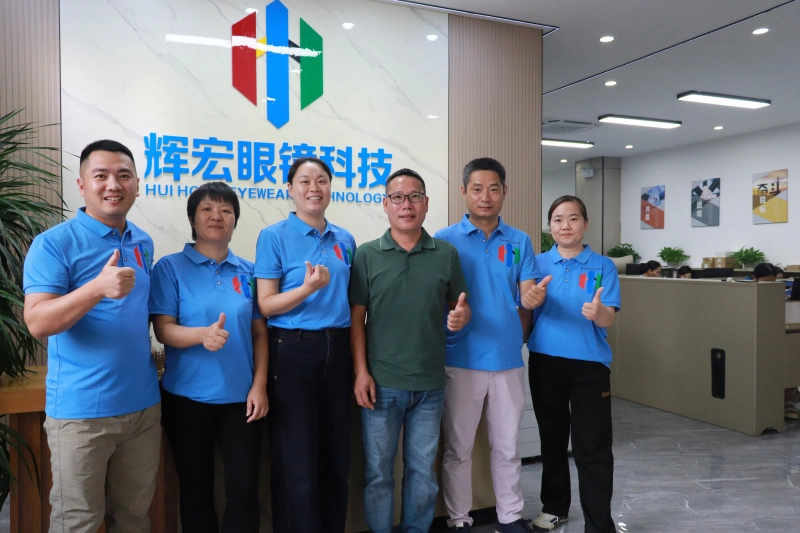
About Shenzhen Huihong Eyewear Technology Co., Ltd.
Huihong Eyewear is a specialized manufacturer dedicated to the design, development, and OEM/ODM production of high-end eyewear. Since our founding, we have collaborated with independent brands, designer labels, and premium retailers worldwide—bringing unique eyewear visions to life through exceptional craftsmanship and reliable service.
We specialize in acetate, titanium, and metal frames, with a strong capability in low-volume, high-quality custom production. From concept prototyping to bulk delivery, we support brands through every step of the journey—with flexibility, speed, and precision.
Our clients span Japan, Korea, Europe, and North America, many of whom return to us not just for quality, but for trust and shared value. Whether you need guidance on lens-to-frame compatibility, material selection for your collection, or full turnkey production, our engineering team works closely with yours to deliver eyewear that performs beautifully and lasts for years.
Final Takeaway
No single lens material dominates across every metric. CR-39 wins on balanced value and optical clarity for daily wear; polycarbonate is unbeatable for safety and impact resistance; nylon offers the best blend of performance and comfort for premium sports and luxury lines; and glass remains the gold standard for pure optical precision and scratch durability.
For eyewear brands, the smartest strategy is to match lens material to your product positioning and customer profile—and work with a manufacturer who understands how frame construction and lens selection interact to produce a superior finished product.
If you are developing a new eyewear collection and need expert guidance on material selection, frame engineering, or custom production, reach out to the Huihong Eyewear team to discuss your project.