Titanium has long been hailed as the premium material for high-end eyewear—ultra-lightweight, hypoallergenic, exceptionally strong, and corrosion-resistant. For independent brands, designer labels, and premium retailers worldwide, titanium frames represent the pinnacle of comfort and durability. Yet behind the sleek, lightweight finish lies a manufacturing reality that separates specialized eyewear factories from the rest.
The truth is: titanium is notoriously difficult to process. Often called “the metal that makes craftsmen shed tears” in precision manufacturing circles, titanium demands specialized equipment, decades of technical know-how, and rigorous process control that most eyewear factories simply cannot afford or master. Below, we break down the core manufacturing challenges that explain why only a handful of manufacturers can consistently produce high-quality titanium eyewear.
1. Inherent Material Properties: A Double-Edged Sword
Titanium’s most desirable characteristics are exactly what make it so challenging to machine.
Extremely low thermal conductivity: Titanium conducts heat at only about 1/5 the rate of steel. During cutting, stamping, or grinding, roughly 80% of generated heat accumulates at the tool tip rather than dissipating through the material or chips. This causes rapid tool wear, surface burning, and microstructural damage that weakens the final frame.
High chemical reactivity at high temperatures: When heated, titanium readily reacts with oxygen, nitrogen, and carbon in the air, forming brittle oxide layers that cause cracking, discoloration, and reduced fatigue life. Even minor oxidation during processing can ruin a frame’s structural integrity and surface finish.
Low elastic modulus (spring-back effect): Titanium has about half the stiffness of steel. When bent, stamped, or machined, it tends to spring back toward its original shape. This makes precision forming extremely unpredictable—what looks correct in the mold may shift out of tolerance once pressure is released, requiring repeated adjustments and leading to high scrap rates.
Work hardening: Each machining pass creates a hardened surface layer that becomes progressively harder to cut. Factories without optimized feed rates and tooling strategies face rapidly dulling tools and uneven surface quality.
For eyewear frames—typically 0.5–1.2mm thin-wall structures—these material properties are amplified. A slight miscalculation in cutting speed or forming pressure can warp, crack, or burn an entire frame.
2. Precision Welding: The Highest Barrier for Titanium Frames
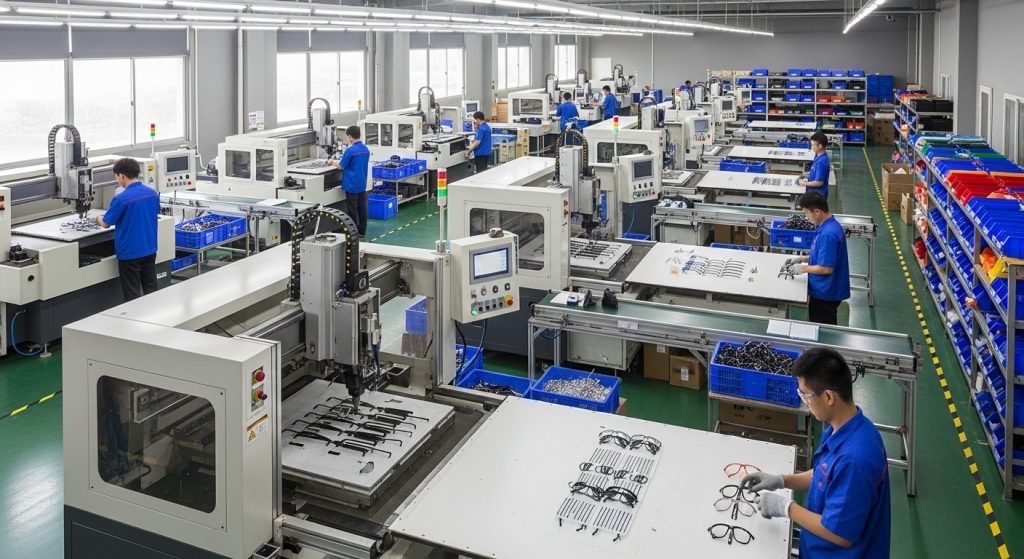
Welding is the single most critical and failure-prone step in titanium eyewear production. Every frame requires multiple weld points: hinges, bridge, nose pads, and end pieces. Traditional welding methods that work perfectly for stainless steel or monel fail catastrophically on titanium.
The core welding challenges:
Oxidation risk: Titanium must be welded in a fully shielded inert gas (argon) environment or under vacuum. Even trace amounts of oxygen at welding temperatures cause brittle weld seams that break easily under normal daily use—especially at high-stress hinge areas.
Heat-induced deformation: With such thin frame walls, excess heat spreads quickly, causing localized annealing that destroys titanium’s natural elasticity. A frame that loses its spring-back property will permanently bend out of shape after a few wears.
Poor weld aesthetics: Conventional TIG or resistance welding leaves rough, discolored weld beads that require extensive grinding. On thin titanium sections, grinding easily eats through the material, creating weak points or ruining the frame entirely.
Dissimilar material welding: When joining titanium temples to stainless steel hinges or other components, mismatched melting points and metal compound formation cause brittle interfaces and premature failure.
Specialized factories invest in precision pulsed fiber laser welding systems with micro-spot accuracy and argon back-shielding—equipment most general eyewear manufacturers never purchase due to high cost and steep learning curves.
3. Forming & Stamping: Controlling Shape in a Rebellious Metal
Creating the curved front rims, temple contours, and intricate details of a designer frame requires precise forming. With titanium, this is far from straightforward.
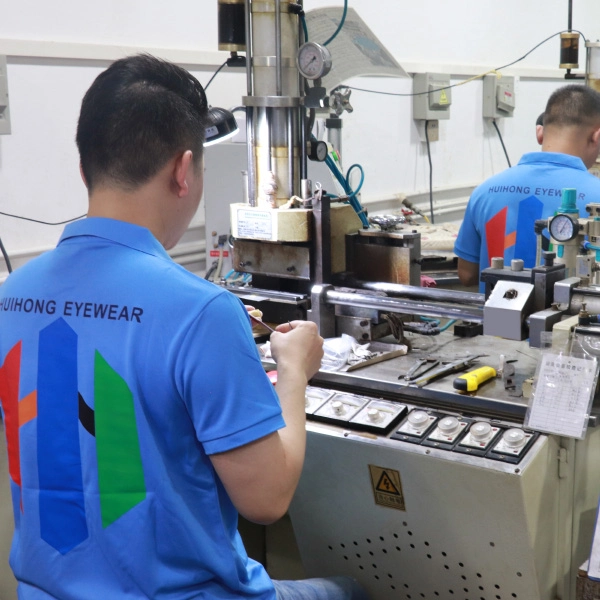
High-temperature stamping requirements: Titanium resists plastic deformation at room temperature. To shape it without cracking, factories must heat the material to carefully controlled temperatures while stamping. Too little heat and the metal cracks; too much and it oxidizes or loses strength.
Rapid die wear: Titanium’s high strength and abrasive nature wear out stamping dies much faster than other metals. Dulls dies produce inconsistent shapes and burrs, increasing rework and reducing batch consistency.
Spring-back compensation: Because titanium bounces back after forming, tooling must be deliberately over-shaped to account for rebound. Calculating the exact over-form angle requires years of empirical data—something new entrants to titanium manufacturing lack entirely.
This is why many factories only offer simple, flat titanium designs and avoid complex, sculpted frame shapes that premium brands demand.
4. Polishing & Surface Finishing: Achieving Smoothness Without Orange Peel
A flawless, lustrous finish is the mark of premium titanium eyewear—but getting there is remarkably difficult.
Titanium’s soft, sticky nature causes a phenomenon known as orange peel effect when polished with standard methods. Instead of becoming smooth and reflective, the surface develops a dimpled, uneven texture that looks cheap and feels rough.
Additional polishing challenges:
Edge over-polishing: Raised edges and corners contact polishing media more aggressively, leading to rounded edges, material loss, and foggy hazy surfaces.
Recessed area under-polishing: Grooves, crevices, and fine details never receive enough abrasive contact, leaving machining lines and dull spots.
Batch inconsistency: Without strict pre-polishing preparation (removing all deep tool marks before fine polishing), the same batch of frames can show wildly different finish quality.
Mastering titanium polishing requires multi-stage processes combining barrel polishing, specialized paste polishing, and hand finishing by highly skilled artisans. It is equal parts science and craft, and cannot be rushed.
5. Dimensional Tolerance & Consistency Control
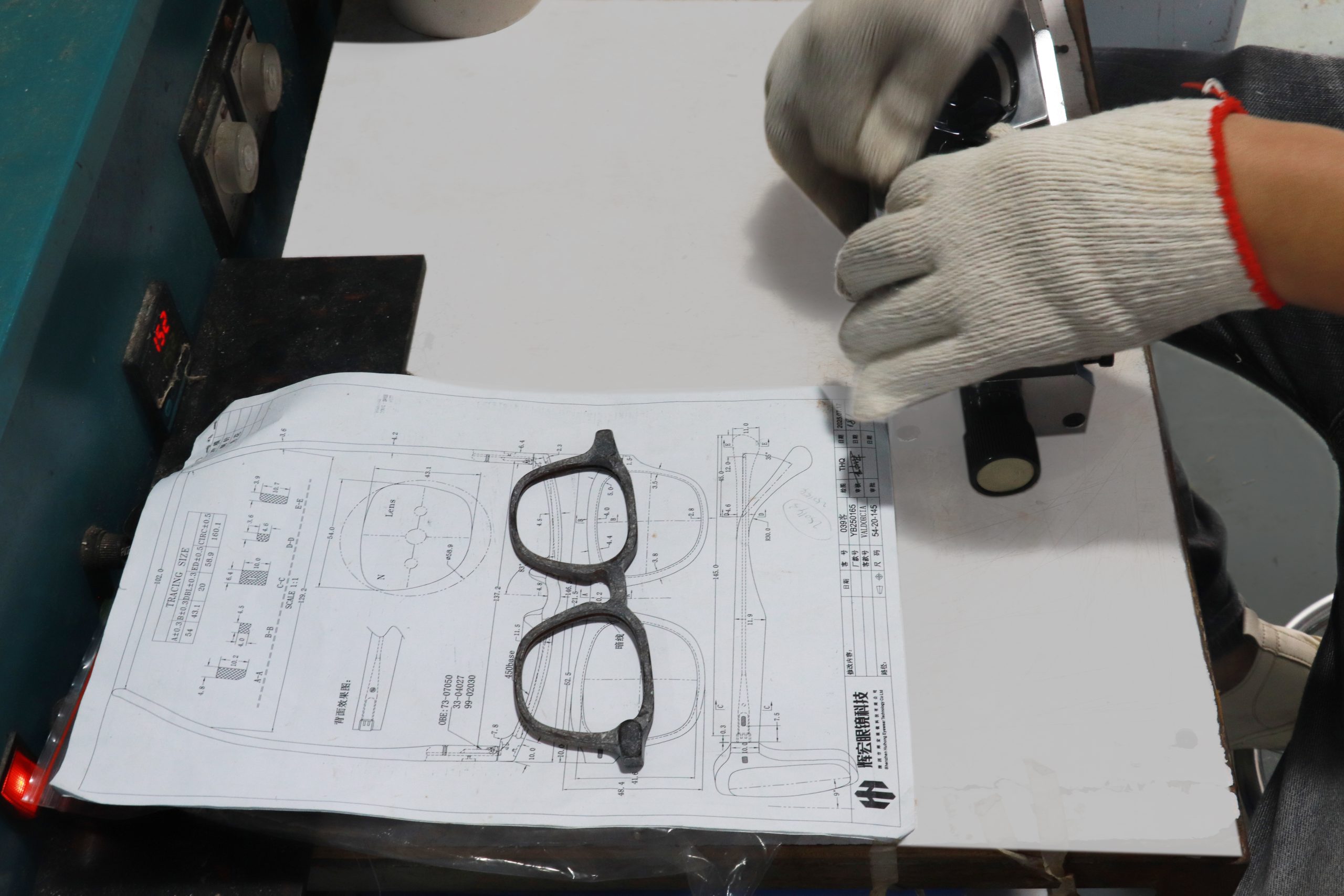
Eyewear requires tight dimensional tolerances for proper fit, lens installation, and hinge function. For titanium, holding those tolerances across production runs is a constant battle.
Tool deflection (“letting the tool walk”): Because titanium has low stiffness, cutting forces cause the workpiece to flex away from the tool. The result: dimensions come out larger than programmed, and features shift position.
Batch-to-batch material variation: Different grades of titanium (pure Ti, β-titanium, α+β alloys) behave differently during processing. Even within the same grade, slight compositional variations require process adjustments.
Post-processing shape change: Operations like heat treatment, surface coating, or even cleaning can cause subtle dimensional shifts in titanium. Factories without robust in-process inspection and corrective protocols produce frames that don’t fit together properly at assembly.
For brands, poor tolerance control means ill-fitting frames, high return rates, and damaged reputation—risks that only experienced titanium manufacturers can reliably mitigate.
6. Equipment, Expertise, and Capital Barriers
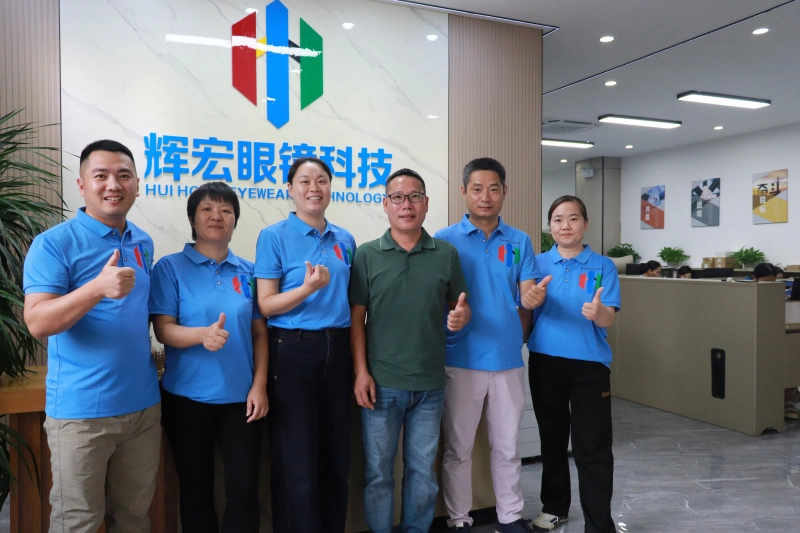
Putting all of the above together requires serious investment that most eyewear factories choose not to make.
Producing quality titanium frames demands:
Pulsed fiber laser welders with argon shielding
CNC machining centers calibrated for titanium cutting
Temperature-controlled stamping presses
Multi-stage polishing lines with titanium-specific media
Vacuum or inert-gas heat treatment furnaces
Highly trained technicians and master craftsmen
Beyond equipment, it takes years of trial and error to build the process knowledge that reduces scrap rates from 30–50% (common for inexperienced factories) down to single digits. Many manufacturers attempt titanium production, underestimate the complexity, and either deliver inconsistent quality or abandon the material entirely.
Why Huihong Eyewear Excels at Titanium Frame Manufacturing
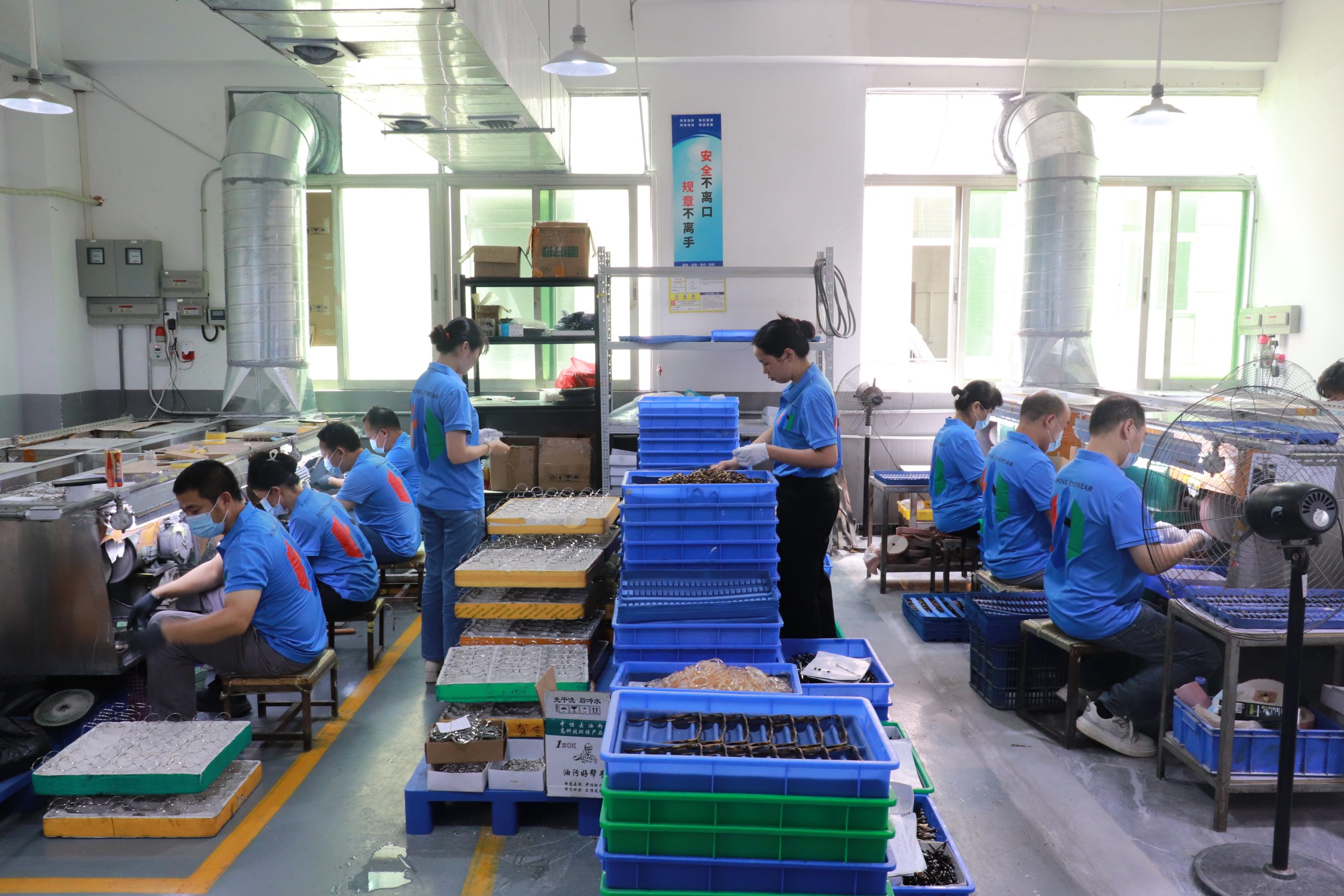
At Shenzhen Huihong Eyewear Technology Co., Ltd., titanium is not an afterthought—it is one of our core specialized materials. As a dedicated high-end eyewear manufacturer focused on OEM/ODM production for independent brands, designer labels, and premium retailers worldwide, we have spent years refining every step of titanium processing.
Deep material expertise: We work across pure titanium, β-titanium, and titanium alloy constructions, selecting the right grade for each design’s performance requirements.
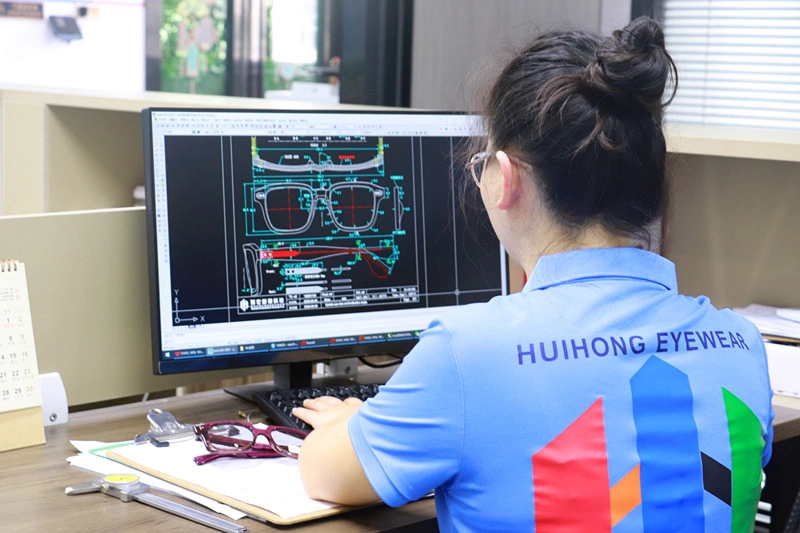
Precision manufacturing capability: From concept prototyping through bulk delivery, we maintain tight process control at every stage—laser welding, CNC forming, multi-stage polishing, and final inspection.
Low-volume, high-quality custom production: We specialize in flexible, fast, and precise small-batch manufacturing, supporting brands through every step of their journey.
Trusted global partnerships: Our clients across Japan, Korea, Europe, and North America return to us not just for quality, but for trust and shared value.
If you are a brand looking to develop premium titanium eyewear, partnering with a manufacturer that truly understands titanium’s complexities is non-negotiable. Cutting corners on titanium processing leads to frames that break, tarnish, and fail to deliver on the material’s promise.