Understanding Your Manufacturing Options: OEM vs. ODM vs. Private Label
Before reaching out to any glasses manufacturer, clarity on production models will save you months of misalignment. Each model serves a different brand stage and budget profile.
OEM Eyewear Manufacturing
Original Equipment Manufacturing means you provide the complete design, technical specifications, and branding requirements, and the manufacturer produces frames to your exact standards. In this model, your brand controls frame architecture, material selection, lens specifications, logo placement, and packaging details.
Best for: Brands with in-house design teams, patented concepts, or a strong visual identity that requires full creative and IP control. Typical lead times range from 45 to 75 days, with tooling costs varying by frame complexity and material type.
ODM Eyewear Manufacturing
Original Design Manufacturing flips the equation: the manufacturer’s in-house design and engineering team develops frame concepts, and you select from existing catalogs or brief them to create custom designs under your brand. The manufacturer handles product design, mold development, technical feasibility, and initial sampling.
Best for: Brands seeking faster market entry, lower upfront R&D investment, or access to proven designs validated by market data. Lead times typically fall between 20 and 45 days for catalog-based customization, and 60 to 90 days for fully custom ODM development.
Private Label Eyewear
Private label sits at the entry level of customization. You select ready-made frames from a manufacturer’s standard collection and apply your logo, custom colors, or packaging. It requires the lowest minimum order quantities and the shortest lead times, making it ideal for new brands testing market demand or retailers expanding house-brand lines.
Key Materials in Premium Eyewear Manufacturing
A professional glasses manufacturer should offer deep material expertise and transparent sourcing. High-end eyewear production relies on several core materials, each with distinct performance characteristics:
Acetate remains the gold standard for premium optical frames. Cellulose acetate delivers rich color depth, hypoallergenic properties, and excellent adjustability. Top-tier manufacturers source premium acetate sheets with consistent material density and UV-stable pigments. Hand-polished acetate frames require skilled craftsmanship across cutting, tumbling, and finishing stages.
Titanium and stainless steel dominate the metal frame segment. Titanium offers an exceptional strength-to-weight ratio, corrosion resistance, and biocompatibility—making it preferred for luxury and lightweight designs. Beta titanium adds flexibility for comfort-focused frames. Stainless steel provides durability at a more accessible price point, often used with IP plating for long-lasting color fastness.
TR90 and advanced polymers serve the performance and lifestyle segment. This thermoplastic material is ultra-lightweight, flexible, and impact-resistant. Advanced manufacturers can incorporate bio-based polymers and recycled materials for sustainability-focused brands.
Each material requires specialized production equipment and quality protocols. A credible manufacturer will be able to explain material tradeoffs, provide material safety data sheets, and recommend the right material for your target price point and use case.
How to Evaluate a Glasses Manufacturer: 7 Critical Criteria
Not all eyewear factories are created equal. When vetting potential partners, evaluate these seven dimensions to reduce risk and ensure long-term compatibility.
1. Certifications and Regulatory Compliance
Regulatory compliance is non-negotiable in eyewear manufacturing. Verify that your manufacturer holds:
ISO 9001 quality management certification
CE marking conformity for the European market
FDA registration for US market access
RoHS compliance for hazardous substance restrictions
ANSI Z80.3 compliance for optical and impact performance
Reputable manufacturers will also maintain material traceability documentation and provide test reports for lens optical clarity, frame durability, and coating adhesion.
2. In-House Design and Engineering Capability
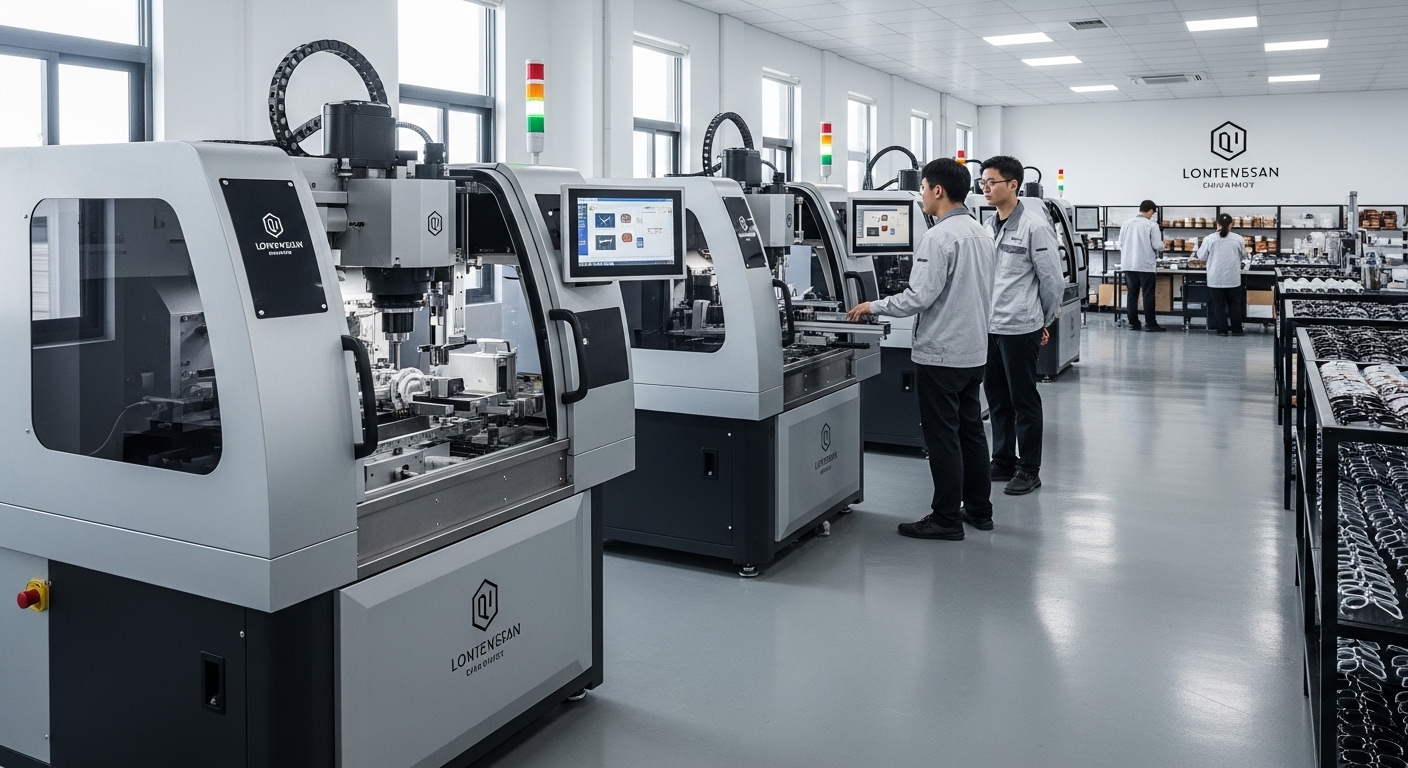
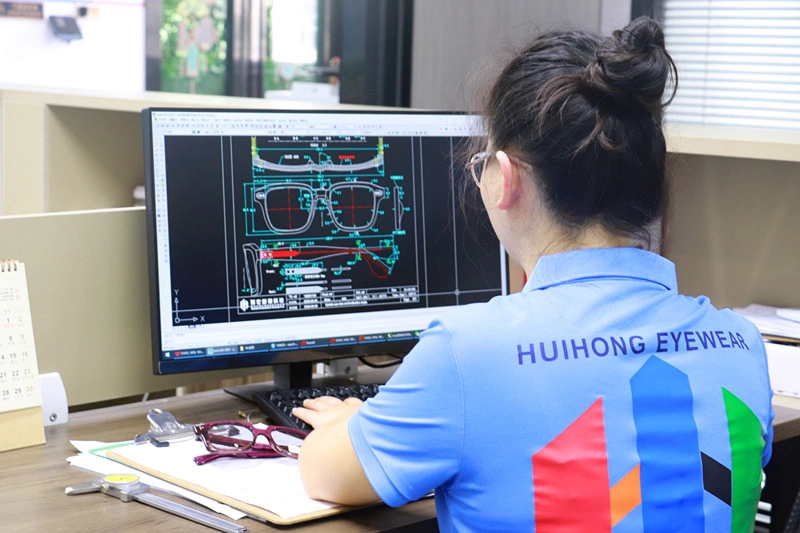
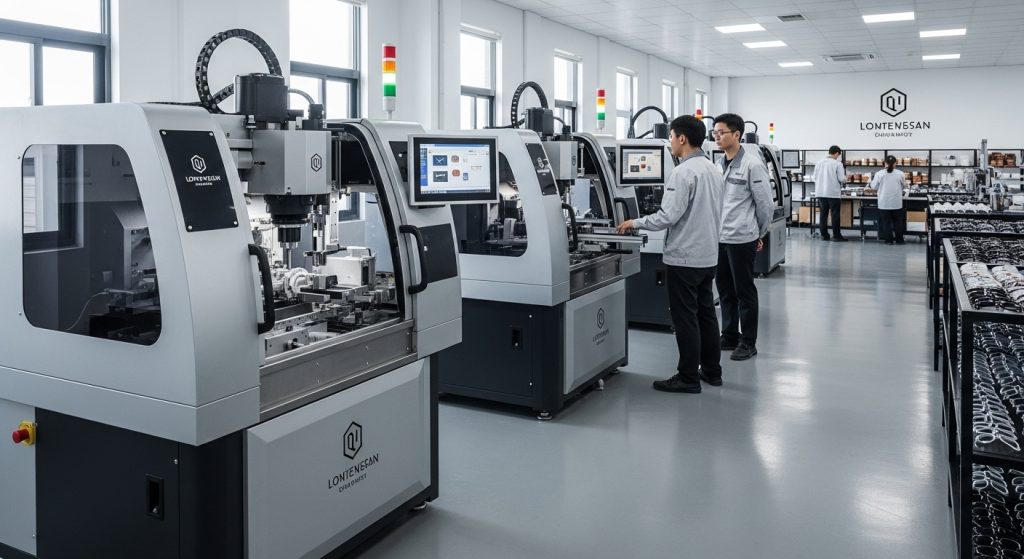
Premium eyewear is as much engineering as it is aesthetics. Look for manufacturers with dedicated CAD designers, structural engineers, and prototype teams on staff. In-house tooling departments significantly reduce development timelines and improve quality consistency. Ask about their 3D prototyping capabilities—modern manufacturers use CNC milling and 3D printing to accelerate sampling cycles.
3. Quality Assurance Process
Quality cannot be inspected into a product at the end of the line; it must be built into every production stage. A robust QA program includes:
Pre-production inspection: Material verification, prototype sign-off, and first-piece approval
In-line inspection: Dimensional checks at key production stations, hinge fatigue testing (minimum 20,000 cycle standard), and coating adhesion tests
Final inspection: AQL 2.5 level sampling covering cosmetic, functional, and packaging criteria
Manufacturers that conduct their own lab testing—including salt spray, climate chamber, and drop testing—demonstrate a commitment to long-term product reliability.
4. Production Capacity and Scalability
Understand a factory’s true capacity, not just their stated maximum. Ask about dedicated production lines, peak season bandwidth, and contingency plans for rush orders. A manufacturer that can scale from small-batch pilot runs to full-scale production without sacrificing quality is the most valuable long-term partner.
5. Minimum Order Quantities
MOQ expectations vary dramatically across manufacturers and materials. Traditional mass-production facilities may require 500+ pieces per style, while specialized premium manufacturers can support lower volumes—often 100 to 300 pieces per model for acetate and metal frames. For startup brands, flexible MOQ terms reduce inventory risk and enable broader style testing.
6. Lead Time Reliability
Delivery reliability matters more than the shortest quoted lead time. Ask about on-time delivery rates, buffer time built into schedules, and how delays are communicated. A trustworthy manufacturer will set realistic expectations and proactively address issues rather than promising unrealistic timelines.
7. End-to-End Service Scope
The best manufacturing partners offer more than production. Look for capabilities including packaging development, lens sourcing and assembly, logistics coordination, and export documentation support. A manufacturer that handles the full supply chain reduces your management overhead and minimizes handoff errors between vendors.
The Eyewear Manufacturing Process Step-by-Step
Understanding the production workflow helps you plan timelines and communicate effectively with your manufacturing partner. Here is the standard process for custom eyewear development:
1. Design Brief and Feasibility Review — You share design concepts, target specs, and volume expectations. The engineering team reviews for manufacturability, identifies potential cost drivers, and suggests material or structural optimizations.
2. Technical Development and Sampling — CAD drawings are finalized, molds are created, and prototype samples are produced. This stage typically involves 1–2 rounds of sample revisions before final approval.
3. Material Sourcing and Pre-Production — Raw materials are ordered and inspected. A pre-production sample is manufactured on actual production equipment to validate process settings.
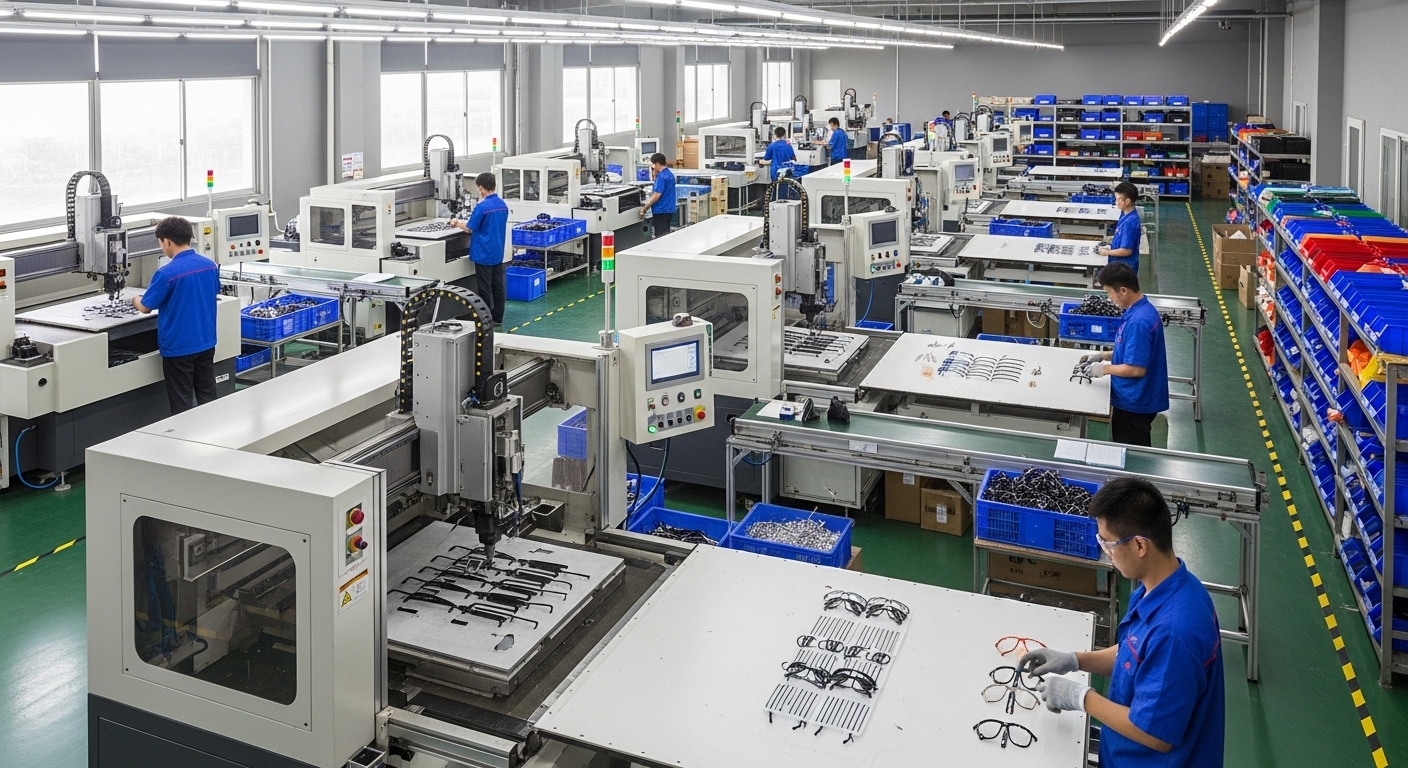
4. Mass Production — Frames move through cutting, forming, tumbling, polishing, assembly, and coating stages. In-line QA checks occur at each transition point.
5. Final Inspection and Packaging — Finished frames undergo comprehensive quality checks, lens insertion (if included), cleaning, and packaging. Final random inspection confirms batch quality before shipment.
6. Shipping and Logistics — The manufacturer coordinates freight forwarders, prepares export documentation, and arranges delivery to your specified destination.
Common Questions About Working with a Glasses Manufacturer
How much does custom eyewear manufacturing cost?
Pricing depends on material, complexity, order volume, and finish level. Basic TR90 frames sit at the lowest price tier, followed by injection-molded plastics, stainless steel, acetate, and titanium at the premium end. Tooling costs range from minimal setup fees for simple modifications to several thousand dollars for fully custom multi-cavity molds. Volume pricing improves significantly at higher quantities due to amortized tooling and material purchasing efficiencies.
What is the typical lead time for custom eyewear?
For private label or logo-customized catalog frames, expect 15 to 30 days. OEM production with existing tooling generally takes 45 to 60 days. Full custom ODM development with new mold creation requires 60 to 90 days from design approval to first production run. Complex designs with specialized finishes or custom components may extend timelines further.
Can a manufacturer help with design if I only have a concept?
Yes—this is exactly what ODM manufacturing is designed for. Experienced manufacturers employ industrial designers and optical engineers who can transform your brand direction, mood boards, or rough sketches into production-ready frame designs. They will also advise on structural integrity, ergonomics, and production feasibility to ensure your concept translates into a durable, wearable product.
How do I protect my design intellectual property?
Work with manufacturers willing to sign non-disclosure agreements and clear IP ownership terms in your manufacturing contract. In OEM arrangements, you retain full design ownership. For ODM projects, negotiate exclusivity periods or design ownership transfers based on volume commitments. Registering your designs in your target markets provides additional legal protection.
What quality issues should I watch for?
Common eyewear defects include loose hinges, uneven polishing, color mismatch between frames, poor lens fit, and coating adhesion failure. These issues are almost always preventable with proper process controls. Your manufacturing agreement should define acceptable defect rates, replacement policies, and corrective action procedures for quality failures.
Building a Long-Term Partnership With Your Eyewear Manufacturer
The most successful eyewear brands treat their manufacturer as a strategic partner, not a transactional vendor. A collaborative relationship yields better pricing, priority scheduling, early access to new materials and technologies, and proactive problem-solving.
Start with a pilot order to validate quality, communication, and delivery performance before committing to large volumes. Share your brand roadmap and sales forecasts so the manufacturer can plan capacity and raw material inventory. Provide clear, constructive feedback on samples and production quality—specific input helps factories improve and align more closely with your standards.
Transparency works both ways. A manufacturer that openly discusses production challenges, shares cost breakdowns, and suggests value-engineering improvements is one worth keeping. The eyewear industry is built on craftsmanship and relationships; finding the right manufacturing partner is an investment that compounds over the lifetime of your brand.