Introduction
Have you ever wondered how a simple sketch on a designer’s tablet transforms into a perfectly crafted pair of eyeglasses resting on your face? The journey from digital concept to wearable product involves over 150 precision steps, blending advanced technology with decades of artisanal craftsmanship.
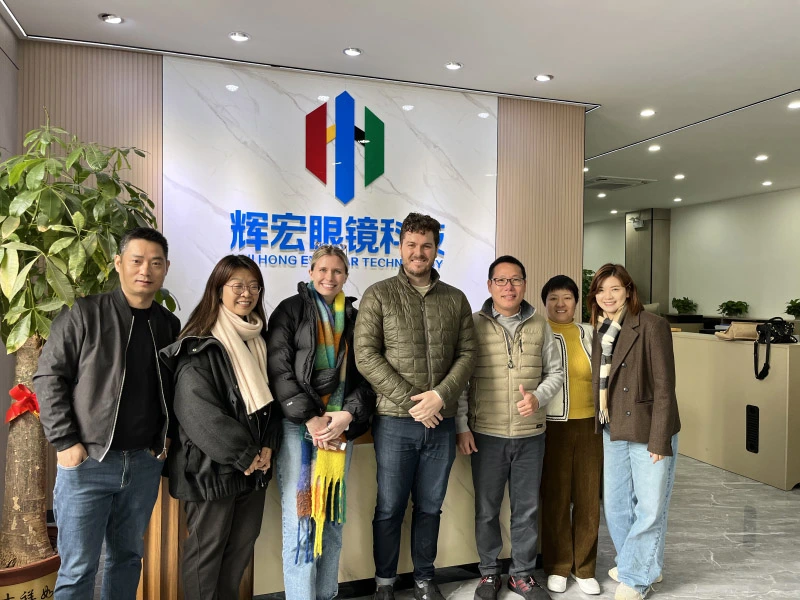
At Shenzhen Huihong Eyewear Technology Co., Ltd., we specialize in turning eyewear visions into reality for independent brands, designer labels, and premium retailers worldwide. This comprehensive guide walks you through every stage of modern eyewear manufacturing—from CAD modeling to final inspection—revealing what it takes to produce high-quality acetate, titanium, and metal frames.
Phase 1: Digital Design & CAD Development
Every frame begins as a digital blueprint. This is where creativity meets engineering precision.
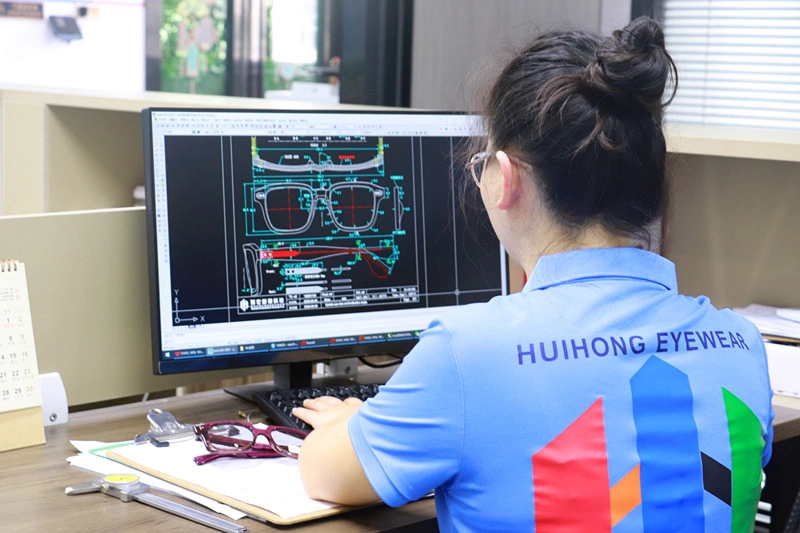
3D Modeling and Technical Drafting
Our design team starts by translating concept sketches into detailed 3D CAD models using industry-standard software. Every dimension is calculated to within 0.1mm accuracy:
Front frame geometry: Lens shape, bridge width, and overall face-form curvature
Temple design: Length, bend angle, and ear-contact ergonomics
Component specifications: Hinge placement, nose pad positions, and wire core paths
Material thickness: Critical for structural integrity and weight balance
Digital Validation
Before any physical production begins, we run digital simulations to test:
Structural stress points under normal wear conditions
Lens fitting compatibility with standard lens shapes
Weight distribution for all-day wearing comfort
Manufacturing feasibility for the chosen material
This digital-first approach drastically reduces development time and minimizes costly physical iteration errors.
Phase 2: Prototyping & Sample Approval
A CAD file on screen is one thing—holding the actual frame in hand is another. Prototyping bridges this gap.
Rapid Prototyping Methods
Depending on the material and complexity, we employ different prototyping techniques:
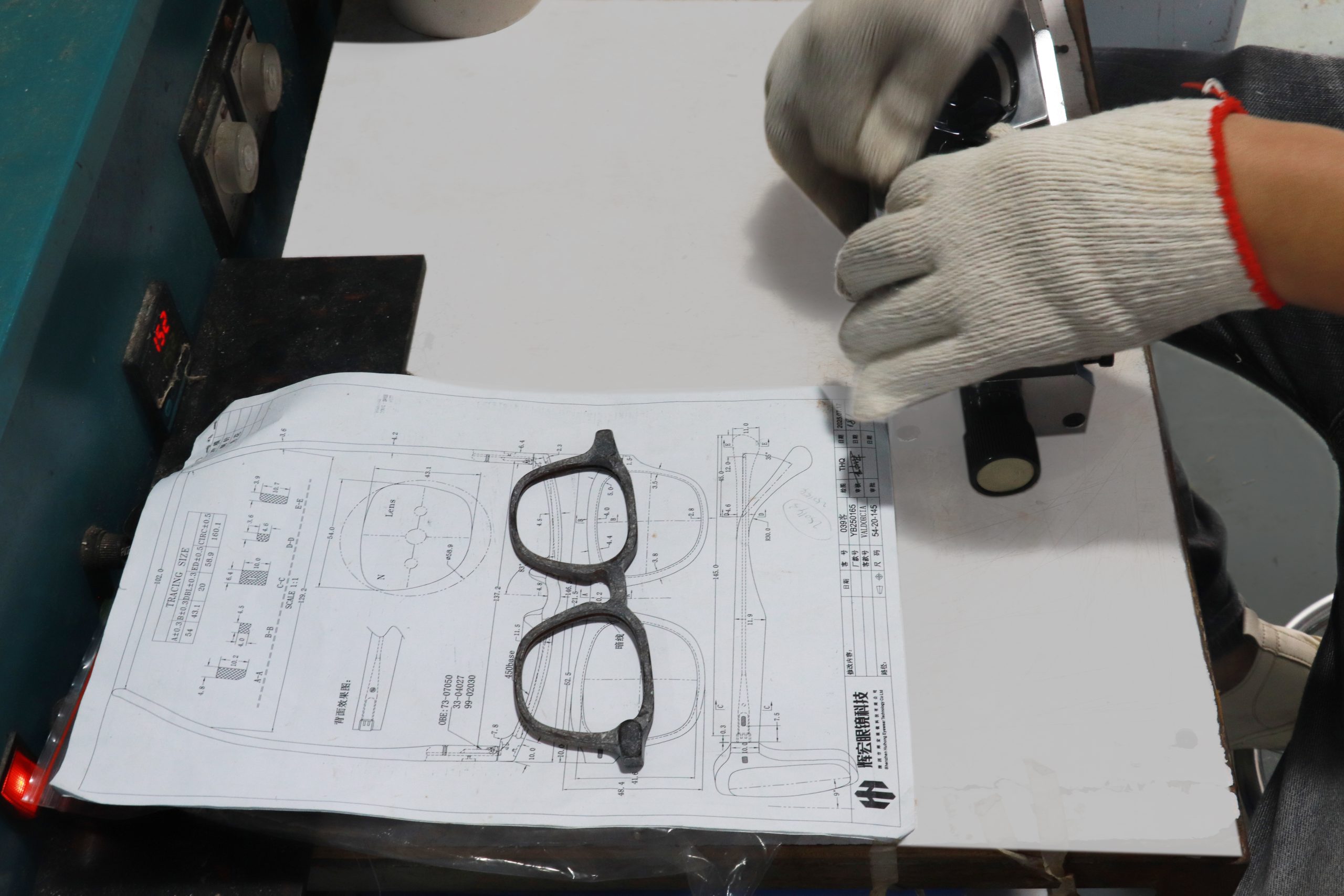
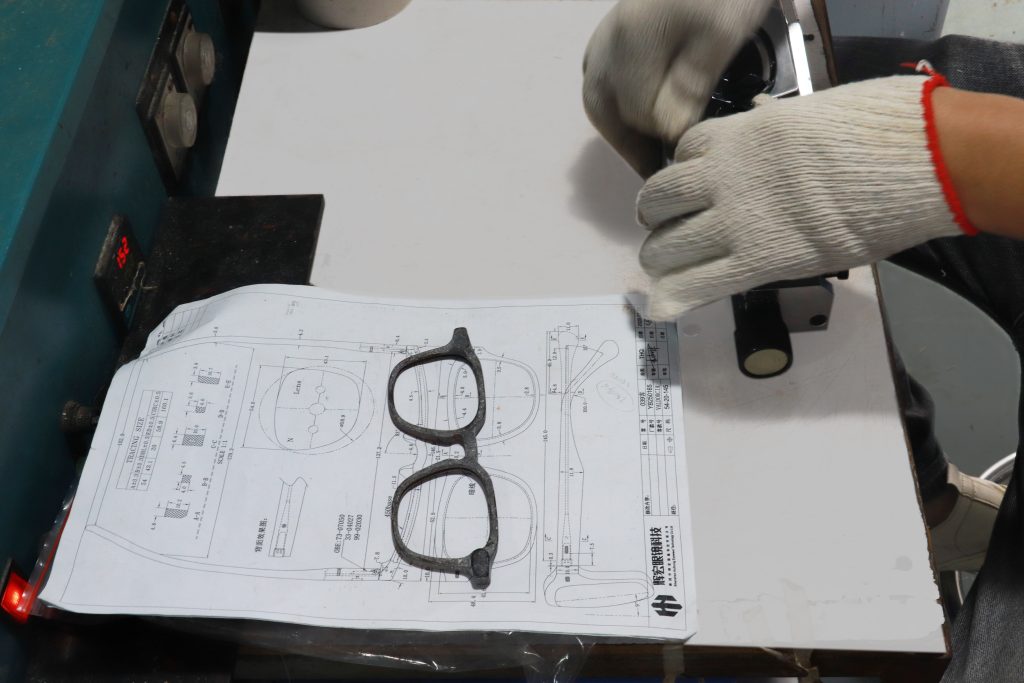
CNC milling for acetate frames: Directly carves a full-size sample from a solid acetate block
3D printing for design verification: Quick plastic prototypes for aesthetic review
Hand-made sample frames for titanium and metal: Wire-bent and soldered by master craftsmen
Sample Review and Refinement
Each prototype undergoes rigorous evaluation:
Fit and proportion check on standard head forms
Functional testing of hinges, temple movement, and lens retention
Weight and balance assessment
Aesthetic review of color, texture, and overall visual appeal
Client feedback is incorporated, and revisions are made until the sample receives final approval. This phase typically takes 7–15 days, depending on complexity.
Phase 3: Material Preparation & Component Fabrication
Once the design is finalized, production moves to material processing. Different materials require entirely different manufacturing approaches.
Acetate Frame Production
Premium cellulose acetate is the gold standard for bold, colorful, and hypoallergenic frames.
Sheet Cutting
High-quality acetate sheets are selected for color consistency and material density
CNC cutters precisely blank out front frame shapes and temple strips from the sheet
Each piece is inspected for material defects and color uniformity
Thermoforming & Shaping
Cut blanks are heated in controlled temperature ovens to soften the acetate
Front frames are pressed into custom molds to achieve the exact face curvature
Temples are shaped with wire cores inserted for strength and adjustability
Rapid cooling locks in the precise shape
Milling and Carving
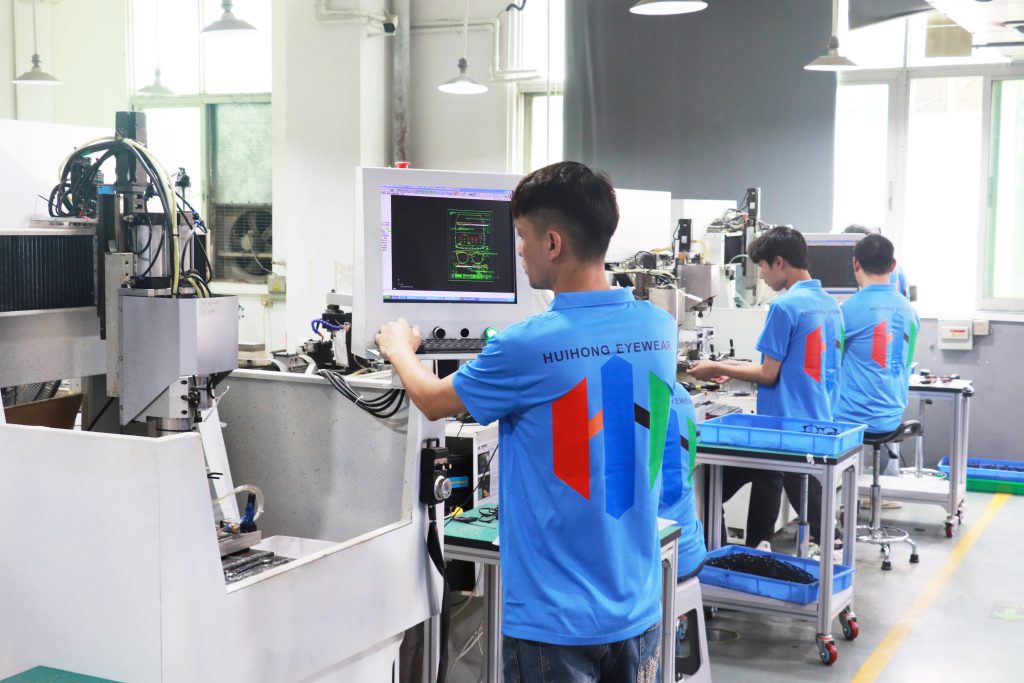
CNC machines mill the lens grooves with micron-level precision
Bridge and end-piece details are carved to exact specifications
Hinge pockets are routed to perfect depth and angle
Titanium Frame Production
Titanium is prized for its ultra-light weight, corrosion resistance, and biocompatibility—making it ideal for premium optical frames.
Titanium Wire Forming
Medical-grade titanium wire is straightened and precision-cut to length
Automatic wire-bending machines form rim shapes following CAD specifications
Bridge wires and temple wires are shaped with consistent spring-back tolerance
Laser Welding
Precision laser welders join titanium components without compromising material strength
Weld points are microscopic and require no filler material
Each joint is inspected under magnification for integrity
Component Fabrication
Nose pad arms, hinges, and end pieces are individually manufactured
Titanium hinges are assembled with stainless steel screws for smooth operation
Parts are tumbled to remove burrs and prepare for finishing
Metal Frame Production
Traditional metal frames (stainless steel, monel, or brass) offer durability and design versatility.
Wire Rolling and Rim Forming
Metal wire is rolled to exact cross-sectional dimensions
Automatic rim-bending machines shape lens rims following the CAD profile
Lock-blocks are soldered to enable lens insertion and tightening
Brazing and Soldering
Bridges, end-pieces, and nose pad arms are brazed onto the front frame
Skilled craftsmen use micro-torches for precision soldering
Frames go through acid cleaning to remove flux residue and oxidation
Temple Manufacturing
Temple wires are cut, shaped, and fitted with core wires
Acetate or silicone temple tips are applied for wearing comfort
Hinges are soldered or riveted to temple ends
Phase 4: Assembly & Fitting
With all components fabricated, the frame begins to take its final form through careful assembly.
Front Frame Assembly
Hinge installation: Barrel hinges are precisely set into the front end-pieces
Nose pad assembly: Pad arms are adjusted and silicone or acetate pads are mounted
Lens lock installation: Screws and washers are fitted to rim locks for full-rim frames
Temple Assembly
Hinge alignment: Front and temple hinges are matched and test-fitted
Screw insertion: Precision screws are installed and torqued to specification
Movement testing: Each hinge must open and close smoothly with consistent tension
Preliminary Fitting Check
Before moving to finishing, every frame undergoes a dry-fit inspection:
Symmetry check across vertical and horizontal axes
Temple opening angle verification
Front frame flatness confirmation
Hinge play and tightness adjustment
Phase 5: Surface Finishing & Polishing
This is where raw frames transform into refined, premium products. The finishing process determines how the frame feels and looks.
Acetate Frame Finishing
Tumbling (Barrel Polishing)
Frames are placed in rotating barrels with wooden pellets, bamboo chips, and polishing compounds
Multiple tumbling stages progressively refine the surface over several days
This removes machining marks and creates a smooth base surface
Hand Polishing
Skilled polishers use cloth wheels with progressively finer polishing compounds
High-gloss finish is achieved through multiple buffing stages
Matte or satin finishes are created with specialized abrasion techniques
Acetane Vapor Smoothing
A brief acetone vapor bath creates a crystal-clear surface finish
This step eliminates micro-scratches and enhances depth of color
Frames are then fully cured and air-dried
Metal / Titanium Frame Finishing
Deburring and Smoothing
All sharp edges and soldering points are ground smooth
Frames go through vibratory tumbling with ceramic media
Surface is prepared for plating or coating
Electroplating or PVD Coating
Electroplating: Multiple layers of nickel, palladium, and gold or rhodium are applied
PVD (Physical Vapor Deposition): Durable, environmentally-friendly coating for titanium frames
Colors range from classic gold and silver to modern black, gunmetal, and custom tones
Final Polishing
High-contact areas are hand-polished for a smooth feel
Logo engraving or printing is applied after final finishing
Protective film is applied to prevent scratches during final assembly
Phase 6: Quality Control & Final Inspection
Quality control is not a single step—it’s woven into every stage of production. Final inspection is the last critical checkpoint.
Multi-Point Quality Inspection
Every frame passes through our QC department with checks including:
Dimensional accuracy: Frame width, lens size, bridge width, temple length verified against CAD specs
Symmetry test: Front frame and temples checked on a precision grid plate
Hinge function: Smooth opening, proper tension, no side-to-side play
Surface quality: Inspection under controlled lighting for scratches, pits, or plating defects
Lens fitting test: Demo lenses inserted to confirm groove dimensions and retention
Adjustability check: Temples and nose pads tested for safe bending range
Functional Testing
Salt spray test for corrosion resistance (metal/titanium frames)
Impact and stress testing on frame joints
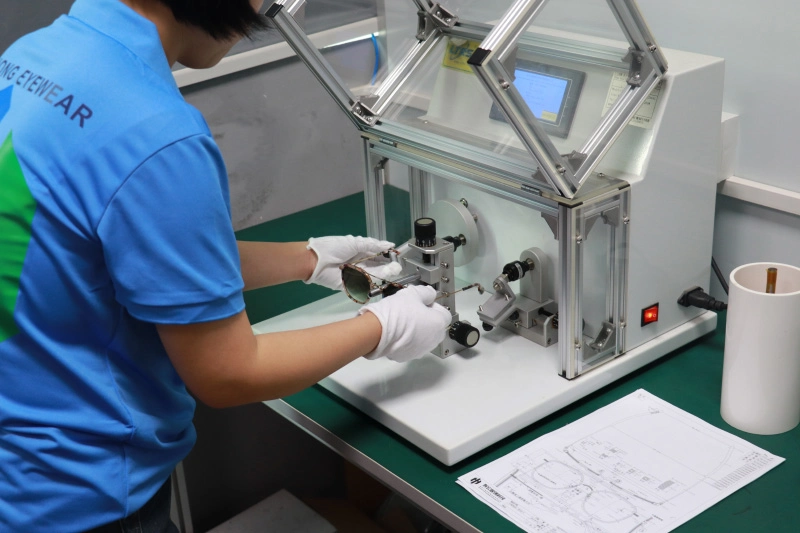
Hinge cycle testing (minimum 5,000 open-close cycles)
Acetate material hardness and flexibility testing
Frames that pass all inspections move to final packaging. Any defects are routed back for correction or rejection.
Phase 7: Packaging & Delivery
The final step ensures frames arrive at their destination in perfect condition, ready for market.
Final Preparation
Demo lenses are cleaned and inspected
Frame information tags are attached (model number, color code, size)
Protective sleeves are applied to prevent scuffing
Packaging Options
Standard polybag packaging for bulk shipments
Custom branded boxes, pouches, and cleaning cloths
Individual retail-ready packaging per client specifications
Barcoding and SKU labeling for inventory management
Shipping and Logistics
Consolidated bulk shipping for large orders
Drop-shipping capabilities for e-commerce clients
Full documentation: packing lists, inspection certificates, and customs paperwork
Trackable shipping via air, sea, or express courier
Why Partner with Huihong Eyewear for Your Production Needs
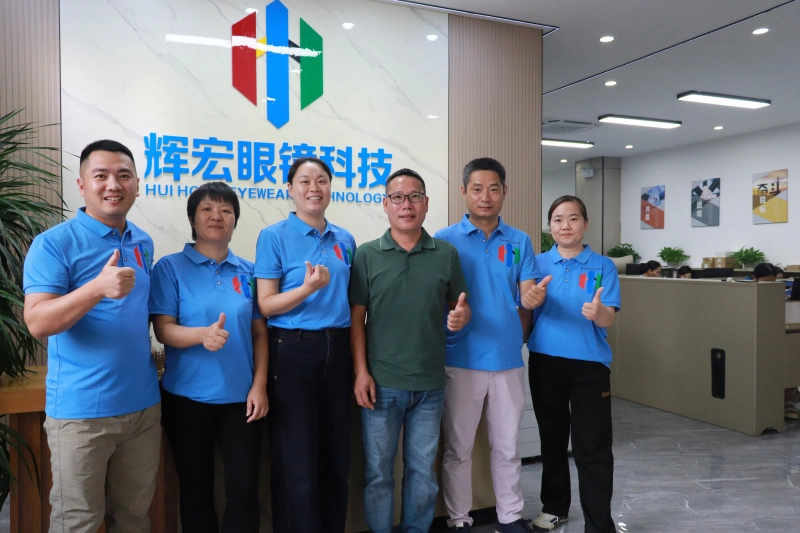
Shenzhen Huihong Eyewear Technology Co., Ltd. is a specialized manufacturer dedicated to the design, development, and OEM/ODM production of high-end eyewear. Since our founding, we have collaborated with independent brands, designer labels, and premium retailers worldwide—bringing unique eyewear visions to life through exceptional craftsmanship and reliable service.
Our Core Capabilities
Material expertise: Full production lines for acetate, titanium, and metal frames
Flexible production: Strong capability in low-volume, high-quality custom production
End-to-end support: From concept prototyping to bulk delivery, we support brands through every step
Global reach: Clients across Japan, Korea, Europe, and North America
Precision and speed: Advanced CAD/CAM technology paired with experienced craftsmen
What sets us apart is our commitment to building lasting partnerships. Many of our clients return to us not just for quality, but for trust and shared value. We treat every order—whether 50 pieces or 5,000—with the same attention to detail and dedication to excellence.
Final Thoughts
Eyewear manufacturing is a remarkable fusion of digital precision and hands-on craftsmanship. A single frame passes through dozens of skilled hands and over a hundred individual processes before it reaches the wearer. Each step—from the first CAD line to the final polish—contributes to the quality, comfort, and durability of the finished product.
Understanding this process helps brands make informed decisions when selecting a manufacturing partner, and helps wearers appreciate the craftsmanship behind every pair of glasses they own.
If you’re looking to bring your eyewear designs to life with a reliable, experienced OEM/ODM partner, Huihong Eyewear is ready to support your vision. Contact us today to discuss your project and request a custom quotation.